****************************************************
Some thoughts stay hidden in our journals for a while before we feel ready to share them. This one started as that, just a quick note about the number thirteen, written on a day when it seemed to stand out. When March brought a Friday the 13th, that familiar superstition resurfaced, and I returned to my journal to share my perspective with you, my readers.
Through this reflection, I realized that our tendency to avoid the number 13 and view it with suspicion reveals more about us than about the number itself. As I pondered it further, I understood that my focus was not truly on the number. Instead, it was on the stories we accept without question and the quiet fears we cling to because we were told to do so.
Ultimately, it is about recognizing when anxious preoccupation clouds our spirit and choosing instead to see these recurring signs as gentle expressions of divine providence, reminders of a grace that sustains us even in everyday life.
With that in mind, I’m now sharing this once-private thought with you, hoping that even a misunderstood number can inspire deeper reflection.
Once upon a time, I kept noticing the number 13 everywhere, from my dreams to the diagrams and artworks on buildings. It even appeared while I was counting aloud to children during storytime. It showed up so often that I started wondering why people treated it as if it were guilty of crimes it never committed. As a born-again Christian, I avoided Tarot cards and Angel decks entirely and focused directly on the Bible, questioning if there was something deeper behind the old “unlucky” label everyone placed on it.
While flipping through my old journals, I came across an entry about the number 13, something I had written nearly eleven years ago, yet the memory still feels vivid. In the days before my daughter’s parent-teacher conference, I had already noticed the number 13 three times; each time, it seemed to stand out. Then, that morning, my name appeared as number 13 on the sign-in sheet. The pattern felt too meaningful or strange to ignore, so I wrote it down later that day. As the week went on, the number kept reappearing; seriously, it was flashing on the stove clock, the microwave, and even my phone, as if it were trying to catch my attention.
As I was writing in my cell phone notepad, I happened to look up, and lo and behold, I saw the number 13 again at the bus stop. By then, my mind felt as though it was playing tricks on me, but I knew I wasn’t hallucinating. It was simply one of those days where the same number kept appearing, almost daring me to notice.
Without 13, sequences felt strangely incomplete, as if the count just hung in the unknown. I had never once heard anyone pause, skip, or mute when it was that number’s turn in a simple count from one to twenty. It was almost comical how buildings everywhere I lived in Toronto, and even then in my apartment in London, leaped from the 12th floor straight to the 14th, banishing 13 like some awkward relative no one wanted to sit at the dinner table.
Why do we blame bricks and hallways for the uncertainty in our own souls, or cling to those repetitive lessons that taught us the number is either cursed or mysteriously lucky? I catch myself thinking, what if I actually requested apartment 13 on the 13th floor? Would that make me invisible, hanging in some superstitious limbo while the other numbers go on without me? I just had a good chuckle; see, I am funny like that!
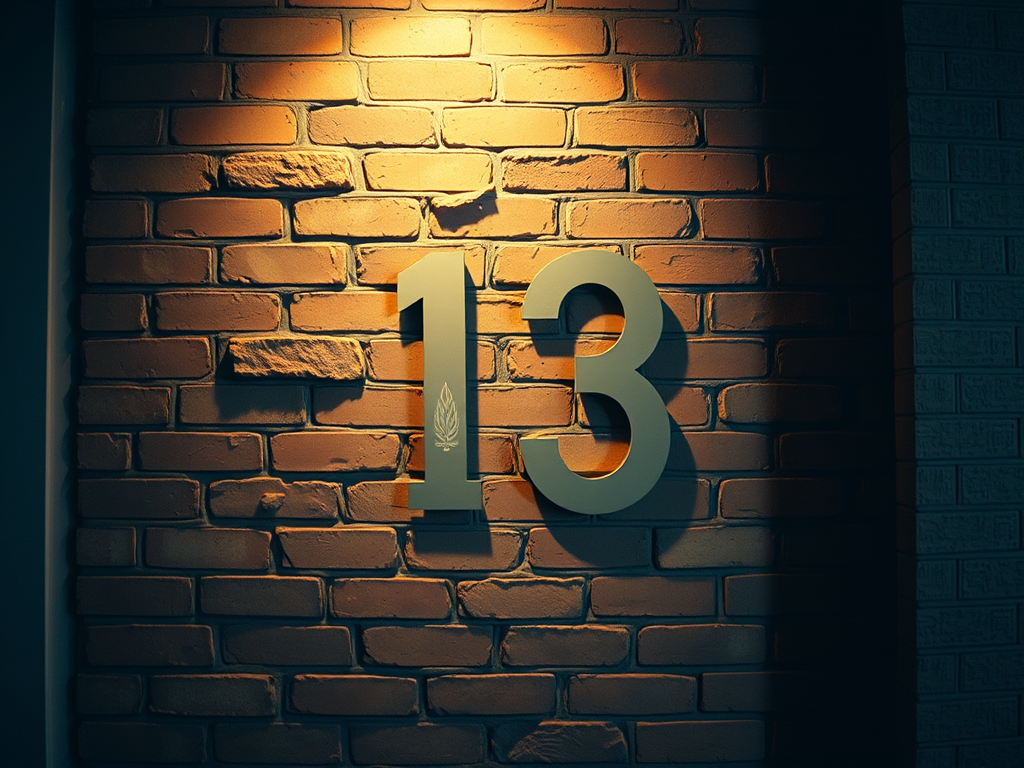
I recently learned that the fear of the number 13 is called triskaidekaphobia. This superstitious belief is deeply rooted in ancient folklore and religious stories, such as the tale of Judas being the 13th guest at the Last Supper, which ultimately led to betrayal. In Norse mythology, some point to the trickster god Loki as the unwelcome thirteenth guest who disrupted a peaceful feast and caused chaos. And there is also the longstanding fear of Friday the 13th, a mix of medieval beliefs that turned an ordinary date into a cultural symbol of bad luck.

I joined the crowd who quietly wondered whether numbers held any real significance at all. My own quick research revealed every label imaginable: an unlucky number, a superstitious trap, a lucky charm, or a symbol of betrayal. It was the kind of thing that could drive someone half-crazy with overthinking until it sounded like a song that never ended. Yet, I still liked the number 13; it completed the pattern and prevented things from stalling between 12 and 14.
Through my research into the number 13, I find the subject surprisingly captivating. Now, at sixty, I reflect more deeply on past sightings, as if I am in a quiet conversation with the Lord about how easily we humans assign meaning to the ordinary. This introspection stems from a season in my life many years ago when everything seemed to be falling apart. During that time, my marriage had ended, and my children were young and confused as we stayed in a shelter for the unhoused. I wrestled with doubt during those days in ways I never had before.
While wide awake at 1:13 a.m. and staring at the ceiling, I opened my Bible to Numbers 13 almost by chance. The chapter describes the twelve spies sent into Canaan, where ten return in fear and rebellion against God’s promise, while only Joshua and Caleb stand firm in faith. An entire generation ended up wandering because of that unbelief and turning away.
Yet, in that quiet hour, the story served as a powerful reminder that although the majority may fall prey to the shadows of fear, there is a deep, unshakable strength in choosing to trust. Even though I didn’t know what would come next for us, I held onto the belief that God would grant us favour with the workers at the shelter. That chapter became an anchor for me, shifting my focus from the giants of my circumstances to the faithfulness of a God who provides, even in the middle of a wilderness.
I remember closing the book and thinking, “Lord, is this me? Am I resisting Your plan because I’m afraid of what’s ahead?”
Seeing the number 13 repeatedly eventually led me to a surprisingly insightful reflection. Instead of viewing it as a sign of bad luck, I started to wonder if the Spirit was using it to catch my attention and invite me to look deeper, not darker. Maybe those sightings weren’t warnings at all, but gentle nudges toward the truth.
And when I reflected on Psalm 13, the pieces began to fall into place. I realized that honest lament is welcome with God, that faith often begins long before our feelings change, and that worship has a way of reorienting the heart. In that light, the number no longer felt ominous. It felt like a reminder that even in seasons of confusion or wandering, God is still drawing me back to trust.
In a further study, evidence from Strong’s Concordance indicates a recurring biblical pattern where the number 13 is associated with themes of destruction and defiance. For example, Strong’s Hebrew H13 refers to obdan, a term specifically linked to ruin in Esther 8:6, where Queen Esther fears the complete loss of her people. This motif of hardship persists in the New Testament, where Strong’s Greek G13 points to Agabus, the prophet who famously predicted a severe famine in Acts 11:28.
Beyond word studies, the number itself often signifies historic moments of rebellion. Genesis 14:4 records that several kings chose their 13th year to rise against their rulers, signalling a clear shift toward insurrection. This legacy of resistance is perhaps best exemplified by Nimrod, the 13th in the line from Adam through Ham, who led the construction of the Tower of Babel in an ultimate act of collective defiance against God.
Scripture never condemns the number itself, but instead shows the results when human hearts choose fear or lawlessness over trust. This perspective became a turning point for me because it reminded me that rebellion leads to wandering, while faith brings rest.
Now, whenever the number 13 appears on a clock or a list, it feels less like a frightening omen and more like a gentle reminder to trust God even when the way ahead seems uncertain. These are simply my own reflections, as the true power lies in the Word rather than in brick structures or clock faces.
Thanks for reading! 😍
*************************************************
Here’s a tip for writing numbers:
Most standard writing styles, such as APA and MLA, require spelling out numbers zero through nine while using numerals for 10 and above. Therefore, you would write 13.
References
New International Version Bible. (2011). Zondervan. (Original work published 1978)
Strong, J. (n.d.). Strong’s exhaustive concordance of the Bible. (Various editions; entries H13 and G13 consulted). https://biblehub.com/hebrew/13.htm (for H13: ‘obdan in Esther 8:6)
https://biblehub.com/greek/13.htm (for G13: Agabus in Acts 11:28)
Purdue OWL: APA Numbers and Statistics

 Keziah Thinks Press